
2 sweet Greek traditions you've never heard of
VILLAGE LIFE & TRADITIONS
Author: Tonia
6 min read
Hidden treasures of Greek culinary culture
When people think of Cretan food, they usually imagine olive oil, fresh vegetables, and slow-roasted lamb. Yet some of the island’s most charming traditions are its sweets, and not only the desserts themselves, but the stories and rituals woven around them.
Let me share two sweet traditions that even many travelers don’t know about.
One is uniquely Cretan, a century-old custom from the Minoa Pediada region (Greek: Μινώα Πεδιάδα, meaning “Minoan Plain”).
The other is a classic Greek treat that has been delighting children and adults across Greece for generations.
Crete's Sweetest Love Messages: Sugared Mantinades (Ζαχαρωτές Μαντινάδες)
Imagine this. It’s a village festival in early 1900s Crete, in the fertile Minoa Pediada region of central Crete, a wide plain about 30 km southeast of Heraklion, where traditions run as deep as the Minoan roots beneath the olive groves. This is also where my cottage is located today.
Among the food stalls and musicians, there’s a special seller, the panigyradas. He offers something magical. Small sugar candies, each one inscribed with a mantinada, the traditional Cretan rhyming couplet.
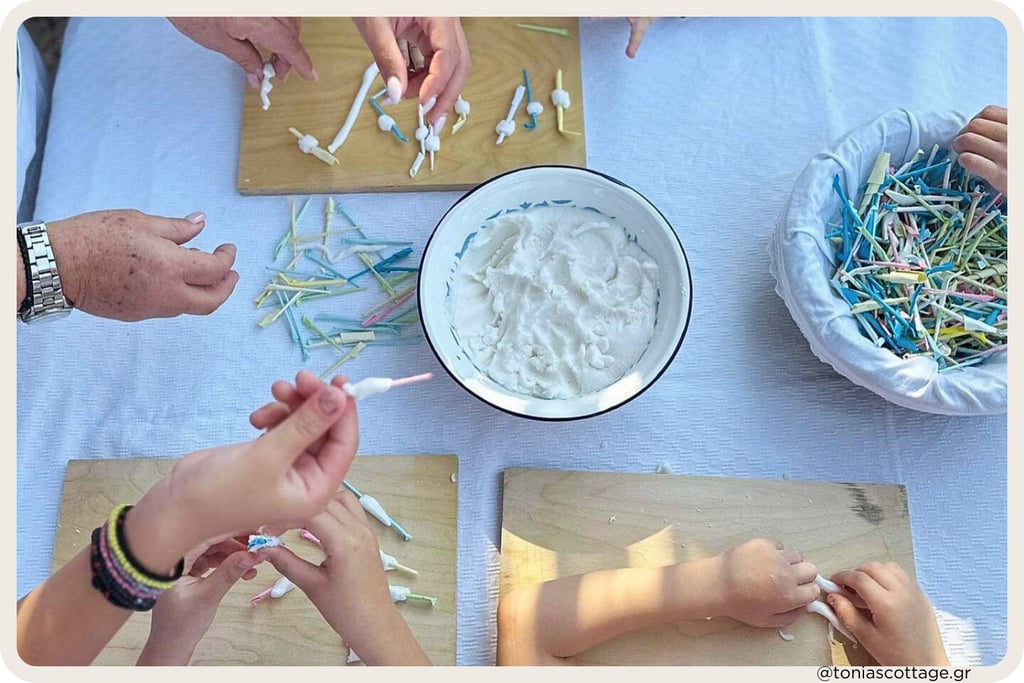
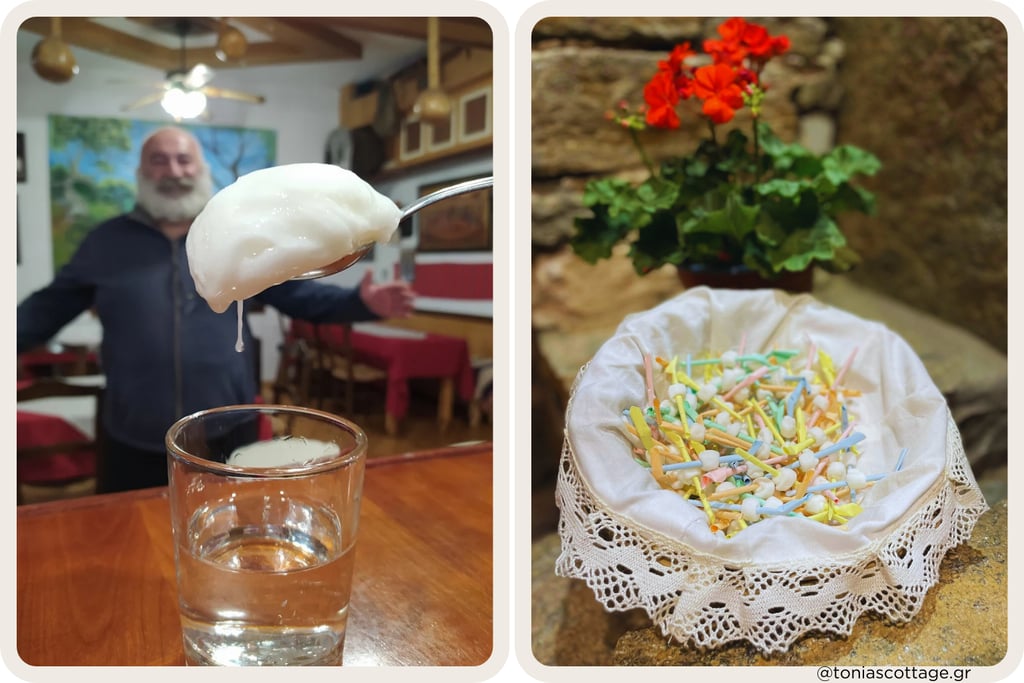
A tiny fortune cookies, Cretan style. Messages of love, longing, hope, and humor wrapped in crystallized sugar. Small sugar rings encircling colorful paper scrolls, sold ten for one drachma and tucked into simple paper cones.
How it worked:
Young people (and not-so-young ones) would buy these sugared mantinades at festivals and celebrations throughout the Minoan Pediada region, especially during the feast of the Holy Apostles on June 28. But here's the beautiful part: you didn't eat them right away. First, you unwrapped the colorful paper and read your mantinada. Then, you'd carefully "study" your beloved's reaction as they read theirs, silently dedicating the random verse to someone special and hoping it would reveal something about their feelings. Later that evening at the dance, you'd wait for a sign, a glance, a squeeze of the hand.
The verses ranged from sweet to playful to heartbreaking:
"Αν μ' αγαπάς με την καρδιά, δείξε μου σημαδάκι,
οντό κρατούμε στο χορό, σφίξε μου το χεράκι."
("If you love me from your heart, give me a little sign,
When we're dancing at the feast, squeeze this hand of mine.")
The astonishing scale of popularity:
To understand just how deeply woven into Cretan culture these sweet messages were, consider this: confectionery shops sold mantinades in massive sacks weighing 40 okes (about 50 kilograms each). A single printing house could produce over one million mantinades in a single print run, and this happened multiple times throughout the year. These weren't rare treats reserved for special occasions, they were an integral part of everyday Cretan social life, consumed by the hundreds of thousands at village festivals, weddings, and gatherings across the island.
Why it matters:
For over a hundred years, from the late 1800s until around 1970, these sugared mantinades held a special place in Pediada’s culture. They were about anticipation, about the thrill of a chance encounter with words that might say what you couldn’t express yourself, about a shared moment of reading, smiling, and wondering what it might mean.
The secret ingredient that made them possible was draganti (δραγάντι), or tragacanth gum, extracted from a thorny plant called Astragalus creticus (known locally as "kentoula") that grows wild in Crete. The ancient Greek philosopher Theophrastus first described this plant's properties, connecting it specifically to Crete. The gum absorbs up to 20 times its weight in water, creating a pliable paste that hardens when dry, perfect for wrapping around tiny paper scrolls.
Making them was labor-intensive family work: candy makers would soak draganti overnight until it became a thick gel, mix it with powdered sugar, shape it into thin cords, and wrap the pieces around cone-shaped paper scrolls printed with mantinades. The candies would then dry on cloth-covered tables for at least 10 days, with glasses of water under each table leg to keep ants away. Multiple generations would sit together preparing these sweet messengers for the festivals to come.
Today:
In 1970, the sugared mantinades mysteriously vanished. No one knows exactly why. Perhaps changing tastes, perhaps the difficulty of sourcing draganti, perhaps the fading of village festivals as young people moved to cities.
However, there's an intriguing, unconfirmed story that adds another layer to this mystery. Some sources suggest that during the military junta years (1967-1974), authorities may have threatened confectioners after politically charged mantinades began circulating among the sweets. The junta was known for its attempts to control any form of expression it couldn't monitor—they even compiled lists of "forbidden" cafés and businesses. Whether this played a role in the mantinades' disappearance or simply coincided with broader social changes remains a tantalizing question.
But something beautiful has happened. In 2011, guided by childhood memories and a deep sense of responsibility toward local heritage, members of the Cultural Association of Apostoli Pediados began making sugared mantinades again. A tradition that had been silent for more than forty years returned to life, shaped by the same care, patience, and joy it once carried.
Today, these sugared mantinades appear again at weddings, baptisms, and summer festivals throughout the Pediada region, the fertile agricultural heartland southeast of Heraklion. They are also featured at the Cretan Cuisine Festival, usually held in August. This festival draws its strength from folk tradition and presents the Cretan diet in an authentic, generous way, not for profit, but for the benefit of the wider community. It celebrates food as culture, memory, and shared identity, giving space to traditions like the sugared mantinades to be seen, tasted, and remembered once more.
Follow the Cretan Cuisine Festival on Facebook for updates on the festival and Cretan culinary traditions (in Greek language).
Greece's most playful dessert: Submarine (Ypovrixio)
Now for something you can find throughout Greece and Crete, though visitors rarely know to ask for it: the ypovrixio (υποβρύχιο), literally "submarine."
What it is:
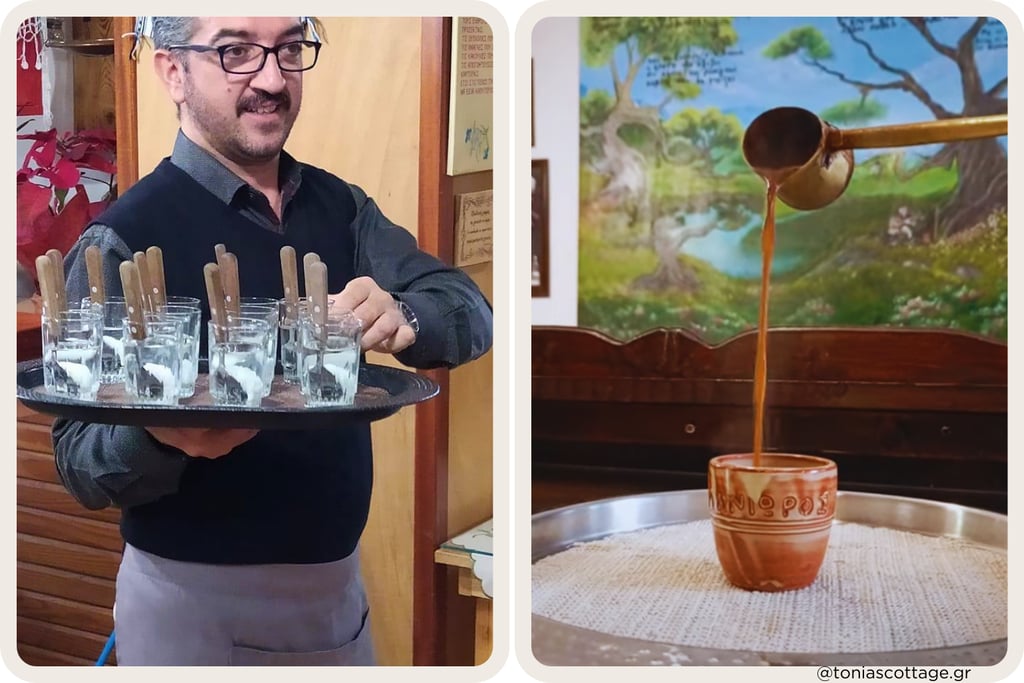
A spoonful of thick, sweet vanilla paste served in a glass of ice-cold water. You "submerge" the spoon into the water (hence the name), let the sweet dissolve slightly on your tongue, then sip the cold water. It's refreshing, playful, and surprisingly satisfying, especially on hot summer days.
There's something almost meditative about eating a submarine. You control the pace: dip the spoon, let it soften, taste the sweetness, sip the cold water. It's interactive dessert, a ritual that slows you down and makes you present.
Children adore it because it feels like a game. Adults love it because it's nostalgic. Many Greeks remember submarines from their childhood visits to the neighborhood kafeneio or zacharoplastio (pastry shop).
Where to find it:
Any traditional kafeneio or café throughout Greece will know exactly what you mean if you ask for "ena ypovrixio, parakalo" (a submarine, please). It comes in vanilla (the classic), but you might also find chocolate, mastic, or fruit flavors.
It’s affordable, usually just €1 to 2, and gives you the thrill of discovering a secret the tourists walking past have no idea exists. Pair it with a strong Greek coffee that isn’t sweet, and you have the perfect Cretan moment, with bitterness, sugar, and tradition in one small, delightful experience.
Why these traditions matter
Both of these sweets represent something deeper than dessert. The sugared mantinades show how Cretans have always woven poetry into everyday life, even into candy. The submarine shows Greek culture's gift for turning the simplest things into moments of joy and connection.
When you're traveling in Greece, whether in Crete or beyond, look beyond the guidebook recommendations. Ask about local traditions. Order the submarine that no tourist knows to request. In Crete, seek out the festivals where old customs like sugared mantinades still live. These small discoveries are the moments that transform a trip into a memory.
Want to discover more hidden traditions? Stay at Tonia's Cottage in Alagni, where you're perfectly positioned to explore the authentic Minoa Pediada region—home to the sugared mantinades tradition and countless other stories waiting to be tasted.
Γλυκιά απόλαυση! (Sweet enjoyment!)
Tonia ❤️
Images from:
https://www.cretangastronomy.gr/2018/01/zaxarotes-madinades-kritis
https://www.facebook.com/profile.php?id=100064800096346
Address
Tonia’s Cottage
Alagni Village, 70300 Arkalochori
Crete Island, Greece
Contact details
(+30) 697 054 0969 (WhatsApp)
info@toniascottage.gr
https://linktr.ee/toniascottage
Made with ❤️
© 2024 Tonia's Cottage | All Rights Reserved
Airbnb | Booking.com | HomeToGo | Vrbo
Property Registration Number (AMA): 00002660089